AI Planner for Anxiety: A Calm Daily System in 30 Minutes

Calm by Design: A Simple AI Planner System for Less Anxiety and More Breathing Room
Anxiety often grows when tasks feel vague, time feels scarce, and priorities keep shifting. A well-set AI planner can reduce the mental load by turning worries into clear next steps, narrowing daily choices, and building gentle structure that still allows flexibility. The goal isn’t a perfect schedule—it’s fewer surprises, less mental looping, and more breathing room.
Why planning can ease anxiety (when it’s done the right way)
Planning helps most when it shrinks the “everything” feeling into a short set of concrete actions. Instead of rehearsing worries, your brain gets a reliable place to store them, which can reduce rumination and decision fatigue.
- Reduces uncertainty by translating “everything” into a short list of concrete actions
- Limits decision fatigue with pre-set defaults (work blocks, breaks, meals, wind-down)
- Creates a reliable “parking lot” for thoughts so the brain doesn’t keep rehearsing them
- Supports realistic expectations by matching tasks to available time and energy
- Keeps flexibility: the goal is fewer surprises, not rigid perfection
For broader context on anxiety and support options, see resources from the National Institute of Mental Health and the American Psychological Association.
What makes an AI planner different from a normal to-do list
A traditional to-do list is a container. An AI planner can be more like a translator and traffic controller—turning scattered inputs into next actions, forecasting overload, and offering scheduling options that match your constraints.
- Turns messy inputs (notes, brain dumps, emails) into structured tasks with clear next actions
- Suggests schedules based on time constraints, priorities, and energy patterns
- Helps break large tasks into small steps that are easier to start
- Automates reminders, recurring routines, and “if-then” fallback plans
- Highlights overload early so plans can be simplified before stress spikes
Common anxiety triggers and the AI-planner feature that helps
| Anxiety trigger | What it feels like | Planner move that helps |
|---|---|---|
| Too many tasks | Overwhelm, paralysis | Daily cap + must-do list (max 3) |
| Unclear next step | Avoidance, rumination | Auto-suggest next action + tiny first step |
| Underestimating time | Running behind, guilt | Timeboxing + buffer blocks |
| Constant interruptions | Frazzled, scattered | Focus blocks + notification batching |
| Fear of forgetting | Mental looping | Capture inbox + trusted reminders |
A calm-by-design setup: 30 minutes to a calmer system
Keep the setup intentionally minimal. The calmer your system, the easier it is to trust—especially on days when anxiety is louder than motivation.
- Choose one “home base” (planner app) and one capture method (quick add widget/voice note) to reduce tool switching
- Create three lists only: (1) Today, (2) This Week, (3) Parking Lot—everything else goes into one of these
- Define three daily anchors: a start routine, a midday reset, and an evening shutdown
- Add buffers: a 15-minute buffer for every 60–90 minutes of commitments to prevent cascading stress
- Set default task templates (email block, admin block, workout, meal prep, tidy sprint) so the day fills itself gently
- Decide a “good enough” standard for routine tasks to avoid perfection spirals
The prompt formula that turns worry into a plan
When anxiety spikes, open-ended planning can feel like staring into fog. A consistent request format helps your planner respond with structure instead of noise.
- Use a consistent structure: Context + Constraints + Energy + Next smallest step
- Example input: “I have 2 hours, low energy, one meeting at 3pm, and I’m anxious about starting—build a simple plan with breaks.”
- Ask for task breakdowns that start with a 2-minute action (open doc, outline 3 bullets, send one message)
- Request gentle language: “Give options, not demands; include an easy fallback if I’m overwhelmed.”
- Generate contingency plans: “If I miss the morning block, what’s the simplest way to still finish?”
Daily rhythm: a stress-lowering routine that stays flexible
A calm rhythm is less about filling every minute and more about reducing the number of times you have to renegotiate your day. Keep it light, repeatable, and kind.
A checklist approach for stress-free living (what to track, what to ignore)
Common pitfalls (and calmer fixes)
When to get extra support
If anxiety is persistent, escalating, or interfering with sleep, work, or relationships, consider professional support. Planning tools can be a helpful support layer, but they aren’t a substitute for care. If panic symptoms, self-harm thoughts, or crisis signs appear, seek immediate help from local emergency services or crisis resources. You can also review the World Health Organization overview of mental health for general background.
A ready-to-use guide and checklist to make setup easier
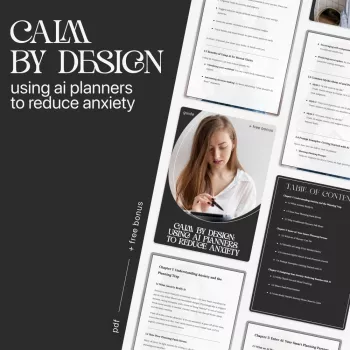
- Calm by Design: Using AI Planners to Reduce Anxiety – guide, eBook & checklist
- Your Ultimate Sleep-Boosting Checklist to Sleep Smart
- Social Confidence in Any Situation printable checklist
FAQ
Can an AI planner actually reduce anxiety, or does it add more pressure?
It can reduce anxiety when it stays simple: daily caps, clear next steps, buffers, and a “minimum viable day” keep the plan supportive. Pressure tends to rise when schedules are overfilled or tracking becomes perfection-based.
What should be planned daily versus weekly to stay calm?
Daily works best for 1–3 must-dos, time blocks, breaks, and the first tiny step. Weekly is better for appointments, deadlines, basic meal planning, recurring chores, and one recovery activity—while the rest can live in a parking lot.
What if the plan falls apart by noon?
Use a reset routine: pause, take a few slow breaths, capture new tasks, choose one must-do, shorten the remaining blocks, and schedule a recovery break. Adjusting the plan is success—it means the system is working with real life.















Leave a comment
You must be logged in to post a comment.