How to Motivate Employees: Interview Answer Framework

Motivate to Elevate: A Practical Guide to Answering “How Do You Motivate Employees?”
Leadership interviews often include questions about motivation because hiring teams want proof you can drive performance without relying on authority alone. A strong answer shows a repeatable approach: understanding what energizes different people, setting clear expectations, removing blockers, and recognizing progress. Below is what interviewers listen for, a simple structure to answer with confidence, and ready-to-adapt examples for common leadership scenarios.
What hiring teams want to hear when they ask about motivation
When an interviewer asks, “How do you motivate employees?”, they’re testing for leadership maturity—especially your ability to balance results with real human needs.
- A clear leadership philosophy: accountability plus support, with standards that don’t depend on “being the boss.”
- Situational leadership: adapting your approach to role type, seniority, personality, and what’s happening in the business.
- Systems over charisma: goals, feedback loops, recognition, autonomy, and growth plans—things that scale beyond personal energy.
- Ethical leadership: no manipulation, fear tactics, or burnout-as-a-badge culture.
- Measurable impact: delivery timelines, quality, retention, engagement signals, and improved performance metrics.
A reliable framework for a strong interview answer
A dependable answer usually follows a simple arc: state your principle, show how you diagnose what each person needs, align to goals, enable execution, reinforce progress, and close with results. If your approach aligns with autonomy, mastery, and purpose (often discussed in modern motivation research), it tends to land well in interviews (see Daniel Pink’s “Drive” overview and the basics of Self-Determination Theory).
Answer blueprint you can use in real time
| Step | What to say | Proof to add |
|---|---|---|
| Principle | “I motivate by creating clarity, autonomy, and growth while holding high standards.” | Team values, operating principles |
| Diagnose | “I learn what drives each person through 1:1s and observing work patterns.” | Notes cadence, questions asked |
| Align | “I connect their goals to impact and set crisp expectations.” | OKRs/KPIs, role scorecards |
| Enable | “I remove blockers and give ownership with the right guardrails.” | Resources, decision rights |
| Reinforce | “I use frequent feedback and specific recognition tied to outcomes.” | Recognition examples, feedback loop |
| Result | “This improved delivery/quality/engagement and reduced churn.” | Before/after metrics |
Motivation levers that work across teams (and how to talk about them)
Use these levers as “menu items” you can reference in an interview, then connect them to a concrete example.
- Purpose: tie tasks to customer value, business outcomes, or mission. Mention how you make impact visible (dashboards, customer quotes, postmortems).
- Mastery: coaching, skill-building plans, and stretch projects with real support (pairing, time to learn, clear success criteria).
- Autonomy: define decision boundaries so people can move without constant approvals, while still protecting quality.
- Progress: break work into milestones and make wins visible without overhyping. Progress reduces anxiety and increases persistence.
- Recognition: timely and specific praise tied to outcomes. Include peer recognition and fair reward practices aligned to culture.
- Fairness: consistent standards, transparent workload distribution, and equitable access to growth opportunities.
- Belonging and safety: respectful debate, learning from mistakes, inclusion in decisions, and a team norm that problems can be raised early.
If you want a credible “why,” you can briefly nod to engagement research—Gallup’s work emphasizes how culture and management practices shape engagement more than perks alone (Gallup: engagement insights).
Examples: ready-to-adapt answers for different leadership situations
1) Underperformance
“I start by clarifying the standard and what ‘good’ looks like, then I diagnose the root cause in 1:1s—skills, unclear priorities, personal constraints, or misalignment. We agree on a short coaching plan with checkpoints, and I remove blockers (training, pairing, better requirements). I reinforce with weekly feedback and clear expectations. In my last role, this approach improved on-time delivery and reduced rework within one quarter.”
2) Burnout risk
“Motivation drops when people feel they can’t win. I reprioritize with the team, reduce work-in-progress, and set a sustainable pace while protecting key outcomes. I make tradeoffs explicit, rotate load fairly, and encourage time off before performance slips. The result is steadier delivery and fewer last-minute fire drills.”
3) New team or reorg
“I do a listening tour first—what’s working, what’s frustrating, and what success should look like. Then we set shared norms, role clarity, and a few quick wins that rebuild confidence. Motivation improves when the team sees progress and understands how decisions get made.”
4) Remote or hybrid team
5) High performers
6) Conflict
Common mistakes that weaken motivation answers
Practice plan: build a confident answer in 15 minutes
Downloadable leadership interview guide
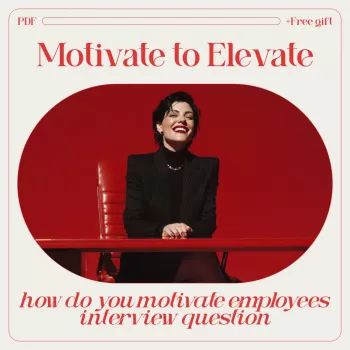
- Motivate to Elevate: A Smart Guide to Answering the Interview Question “How Do You Motivate Employees?” (download) — includes an answer blueprint, example scripts, and tailoring prompts for different leadership roles.
- Social Confidence in Any Situation (printable checklist download) — useful for calmer delivery, clearer storytelling, and stronger presence in high-stakes conversations.
- Your Ultimate Sleep-Boosting Checklist to Sleep Smart (digital download) — helpful for staying sharp during interview prep and early onboarding weeks.
FAQ
What is the best way to answer “How do you motivate employees?” in a leadership interview?
Use a simple structure: principle → how you diagnose individual drivers → how you align goals → how you enable performance → how you reinforce with feedback/recognition → measurable results. Add one concise example with a clear before/after outcome.
How can motivation be shown without sounding like micromanagement?
Emphasize clarity and autonomy: define outcomes, give ownership and decision boundaries, remove blockers, and use lightweight check-ins focused on learning and progress rather than control. Mention how you measure progress without hovering (shared dashboards, milestone reviews, written updates).
What if a team member is not motivated by recognition or rewards?
Personalize your approach by exploring intrinsic drivers like mastery, impact, and autonomy, then co-create a growth plan while keeping expectations clear. Motivation often improves when the work fits the person’s strengths and the path forward feels achievable and fair.















Leave a comment
You must be logged in to post a comment.