Most Grounding Yoga Pose: Child’s Pose + Options
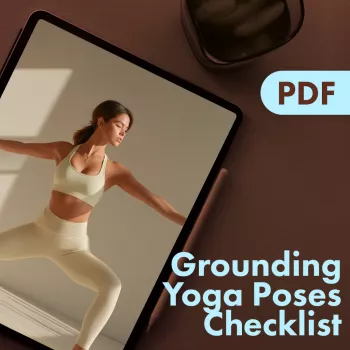
What is the most grounding yoga pose?
For many people, the most grounding yoga pose is Child’s Pose (Balasana). It’s low to the ground, naturally calming, and easy to adjust for different bodies—making it a reliable “reset” when the mind feels busy or the nervous system feels overstimulated.
Why Child’s Pose feels so grounding
Grounding poses usually share a few traits: lots of body contact with the floor, slower breathing, and a sense of containment. In Child’s Pose, the front body softens, the back body broadens, and the forehead can rest on the mat or a prop. That gentle pressure and stillness can help the body shift from “on alert” to “settled,” especially when paired with steady, quiet breaths.
How to do Child’s Pose (with simple options)
Start on hands and knees. Bring your big toes together, then widen your knees as comfortable. Sit your hips back toward your heels and walk your hands forward, letting your chest melt toward the floor. Rest your forehead on the mat, a block, or stacked fists.
If your hips don’t comfortably reach your heels, place a folded blanket behind the knees or between the hips and heels. If the knees are sensitive, keep the knees closer together or put a bolster under the torso for a more supported version.
When another pose may feel more grounding
Child’s Pose isn’t ideal for everyone—especially if deep knee flexion is uncomfortable. If that’s the case, consider a similarly grounding alternative like Legs-Up-the-Wall (Viparita Karani) or a Supported Savasana with a pillow under the knees. The “most grounding” choice is ultimately the one that lets your breath slow down without strain.
Learn more
For step-by-step variations and additional grounding options, visit https://luxifyo.com/what-is-the-most-grounding-yoga-pose/.
FAQ
What is a good grounding yoga sequence for anxiety?
A simple option is 1–2 minutes of slow breathing, then Child’s Pose, a gentle seated forward fold, and a supported Savasana. Keep transitions slow and choose shapes that feel steady rather than intense.














Leave a comment
You must be logged in to post a comment.